


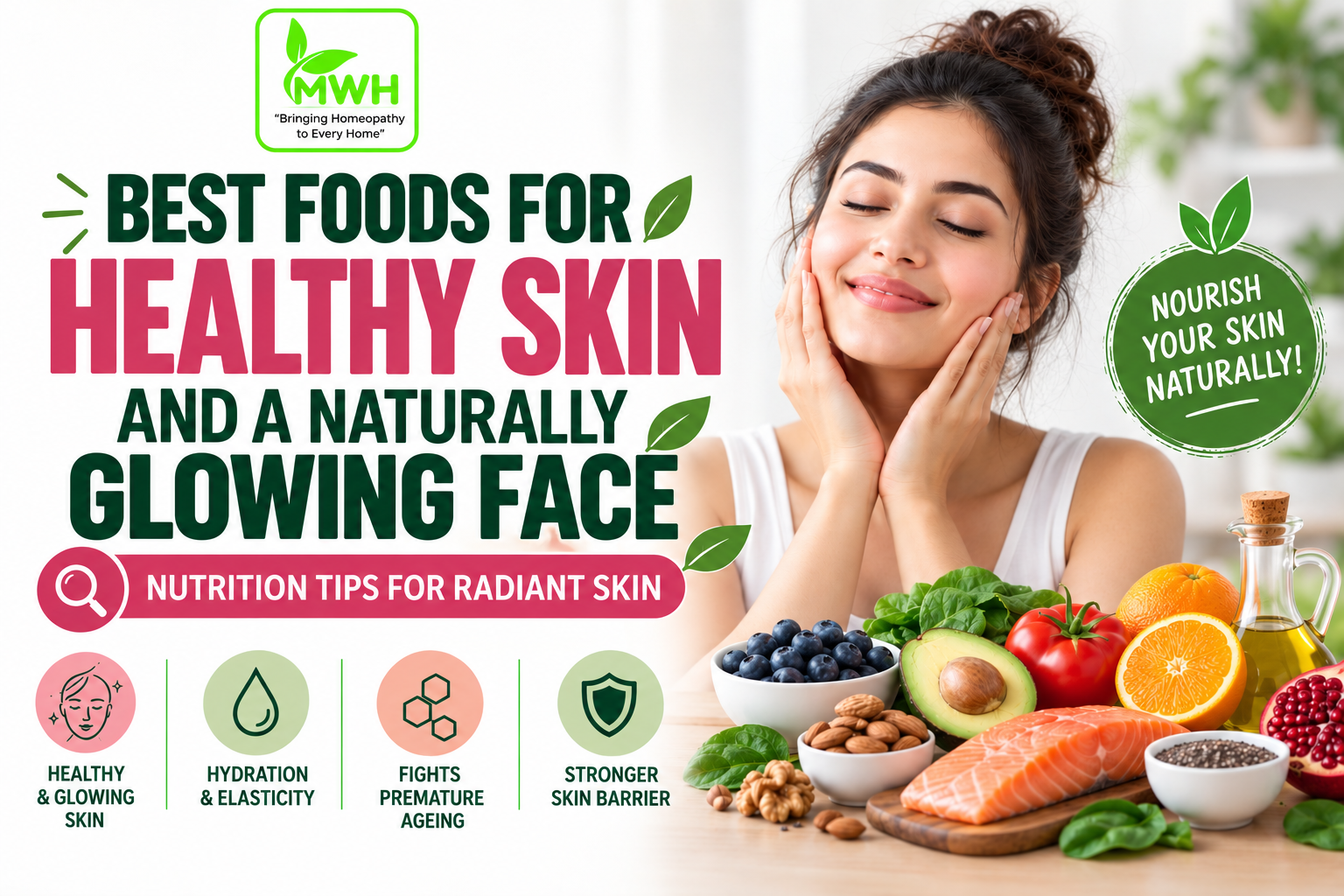
Best Foods For Healthy Skin And Glowing Face
Our skin is like a daily health report. Whatever is happening inside shows outside. If hydration drops, your face looks tired. If vitamin C and zinc go up, you glow. If digestion slows down, you look dull. And when you regularly eat food which is rich in antioxidants for skin, you have a steady glow. Let’s discuss the best natural diet foods that are not only good for your skin health but for our weight management too. You must understand that you should give your body the exact nutrients that build, protect, and repair your skin every single day.
Six foods are so beneficial for the skin that even costly market supplements cannot compare. If your skin is becoming dull, you appear older than your age, or skin problems bother you, then these six foods must be included in your diet.
Skin is the visible organ in the body. If our skin is dull or has spots, it lowers our self-confidence. So, considering the importance of keeping skin healthy and radiant, let’s talk about six foods that are probably the best in this regard.
Starting with number one on the list is amla. Whether it is for eye health, hair health, diabetes, digestion, or immunity, amla always comes out on top. One fact about amla that catches the eye is its high vitamin C content. Amla contains 20 times more vitamin C than an orange, and the importance of vitamin C for the skin is quite evident from the fact that the Indian skincare market is full of vitamin C products. Actually, vitamin C is the primary nutrient responsible for collagen production in our skin. There is another plus to consuming amla. Studies show that when vitamin C intake is increased, the liver produces more glutathione. You might already know that glutathione is an antioxidant that reduces dark spots on the skin and restores the original skin tone. Your body will make enough glutathione on its own and in the most absorbable form.
The next food on the list is beetroot. Beetroot is no less than a superfood for the skin. There are many reasons why eating beetroot benefits the skin, but there are three main reasons. The first is that beetroot contains betalains, which give beetroot its deep red-purple color. These betalains help a lot in liver detoxification. When the liver gets overloaded with toxins, acne and dullness start appearing on the skin. But by eating beetroot, the liver gets detoxified, and its effect shows up on the skin. The second reason is that eating beetroot increases hemoglobin, and there is not much doubt that people who have higher hemoglobin in their body naturally have pinkish and radiant skin. The third is that beetroot contains nitrates, which combine with oxygen in the blood to form nitric oxide. Now, nitric oxide dilates blood vessels, which increases blood circulation. And we know that if blood circulation increases on the skin, the skin will naturally glow. You might be surprised to know that eating 100g of beetroot increases blood circulation in the whole body by 10 to 20%, which is equivalent to 20 to 30 minutes of facial yoga. The only difference is that the effect of beetroot is long-lasting, whereas the effect of facial yoga is short-lived. You can eat beetroot as a salad, juice it, or grate it and knead it into dough.
The next skin superfood on the list is coconut. The main purpose of applying a moisturizer on the skin is to keep the skin’s moisture intact. You will be amazed to know that coconut is a food that works as an internal moisturizer for the skin. Coconut contains medium-chain fatty acids, especially lauric acid, caprylic acid, and capric acid, in exceedingly high amounts. These healthy fats in coconut act as a strong barrier on the skin, which increases the skin’s moisture retention capacity. As a result, the problem of dryness goes away, and even wrinkles do not form quickly. No wonder coconut is considered nature’s own emollient. Another benefit of coconut is that it is an excellent prebiotic. Eating it increases the population of healthy gut bacteria, and when healthy gut bacteria increase, the digestion process naturally smoothens up. And when digestion improves, the body can detoxify itself properly, which reduces inflammation on the skin and brings out a natural glow. Coconut also contains vitamin E, which is helpful for skin healing.
Now the question arises: how should I eat coconut to maximize its benefits for my skin? Coconut will yield amazing results if you start eating its flesh. You can have it as a snack; it’s crunchy and highly satiating. You can even make coconut chutney and eat it with idli or dosa for breakfast. Coconut water is undoubtedly a great food. It contains electrolytes that aid in hydration.
Let’s now talk about the next food, which is carrot. Nowadays, retinol-based skin products are becoming very popular. Retinol slows down skin aging, improves skin texture, and tightens skin pores. Carrot is a very rich source of beta-carotene, which the body converts into active retinol. You can easily eat carrots as a salad before lunch. You can also drink carrot juice anytime during the day. Eat carrots as a vegetable, salad, juice, and even as halva. Your skin will bless you.
The next food on the list is pomegranate. Pomegranate is a food that is no less than any high-end face serum. In Ayurveda, pomegranate is called “dadima” and is especially prescribed to calm down excessive body heat. Body heat, as we all know, is a major cause of skin problems, especially pimples and red spots. Modern science has a different way of saying this. Researchers found that it is the powerful polyphenols in pomegranate that help in healing sunburns. Did you know that just one pomegranate has three times more antioxidants than green tea and red wine? Not only that, the antioxidants in pomegranate are quite unique. According to scientific studies, if someone eats pomegranate daily for a month, even old acne scars start fading. Pomegranate is also a rich source of vitamin C, which means eating it boosts both collagen and glutathione. Pomegranate seeds contain many volatile oils that not only lubricate skin layers but also help clean the stomach properly.
Last but certainly not least is saffron. For skin glow, the best ingredient is saffron oil. But saffron is not just for topical application. Oral consumption of saffron is also scientifically proven for skin rejuvenation. Actually, saffron contains a compound called crocin, which suppresses melanin production in the skin. The bioavailability of crocin in saffron is so high that scientific studies say that if someone takes a very small amount of saffron daily for three to five weeks, dark spots and hyperpigmentation on the skin start reducing on their own. Perhaps it is due to such exceptional anti-pigmentary properties that saffron is considered one of the best skin foods.
Now the question arises how to use saffron for skin? There are two simple ways to use saffron. One way is to drink saffron water on an empty stomach in the morning. Before sleeping at night, soak three to four strands of saffron in 50 ml of water and cover it. In the morning, drink it. After drinking saffron water, if you don’t eat or drink anything for at least half an hour, it will give you very good results. The second way is to boil three to four strands of saffron in milk before sleeping at night and drink it.
Still, if you feel it’s not in your budget, you can drink turmeric milk instead. The curcumin in turmeric helps a lot with skin problems like acne, psoriasis, and eczema. We eat turmeric daily anyway. Turmeric is good in daily cooking too. But if boiled with milk, its direct action is on the blood, which has quite an effect on the skin. Make sure to add black pepper along. That’s because black pepper has piperine that has been scientifically proven to increase curcumin absorption by as much as 2,000%.
Now, let’s quickly look at what to reduce. Avoid deep-fried food, sugary snacks, packaged juices, tea after meals, late-night dinners, and very salty foods. These things create inflammation and water retention, and they block the nutrients your skin needs. When you follow this kind of routine regularly, your skin naturally starts glowing because your body gets what it needs to stay healthy. So, eat well, drink enough water, walk well, sleep on time, and keep your mind peaceful. Your skin listens to everything you do.